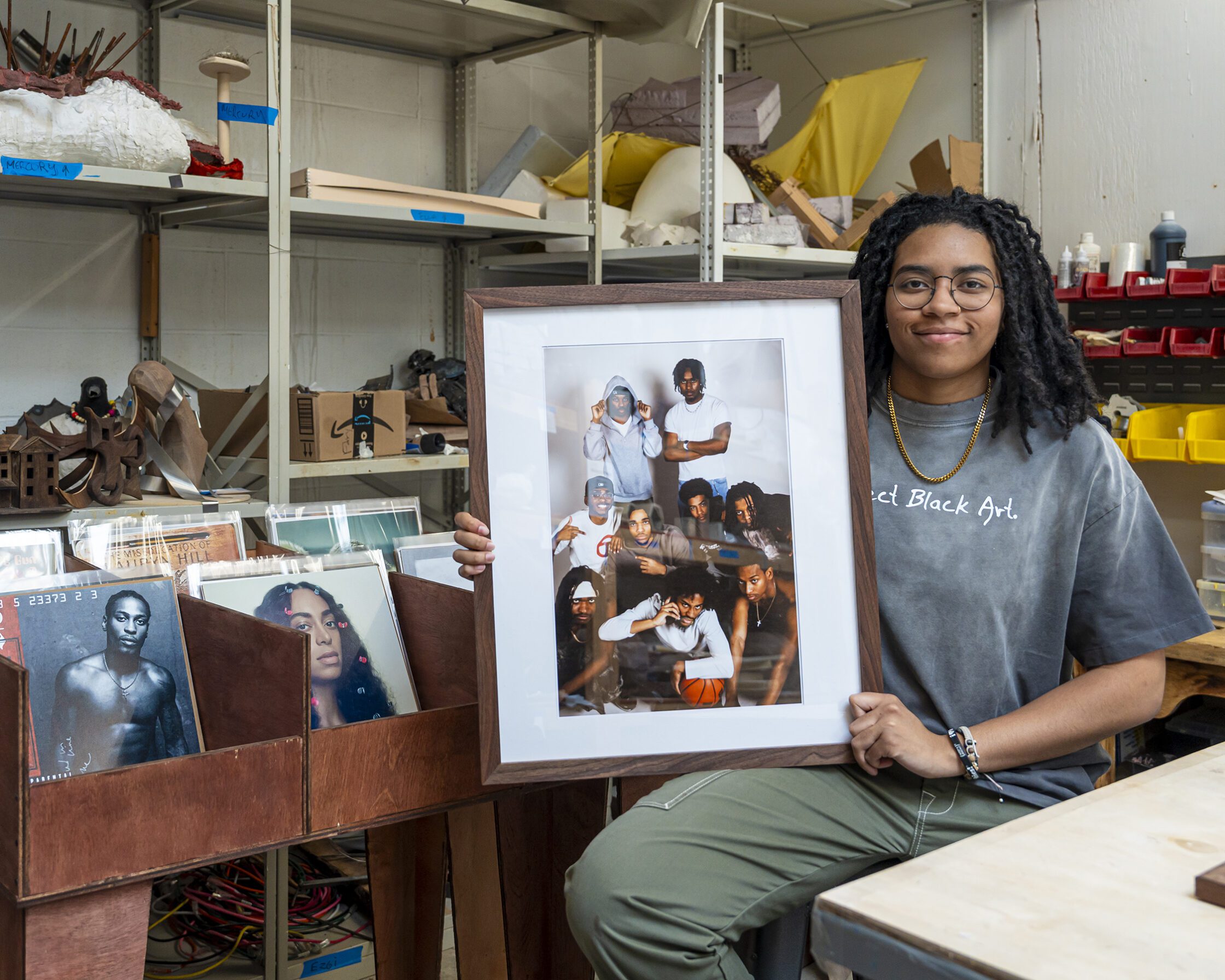
Ella Mbanefo ’26 wrote two theses, one for fine arts and the other for English. Together, they construct a world.
“Cyphers: Portraits of a New Black Arts Movement” traces the visual, emotional, and political landscape of contemporary Black creativity through music and fashion. Mbanefo drew on the sounds of artists like Erykah Badu and Kendrick Lamar to translate rhythm and mood into portraiture. Her collages incorporate vintage issues of Essence, Jet, and Ebony to fold Black visual history into the present, while fashion and hair serve as language and archive. The project, sequenced like an album, argues that the Black Arts Movement is not a closed chapter of history but a living, experimental force.
The spark came from an English course with Professor of English Asali Solomon, whose teaching on the New Black Arts Movement was so influential that Mbanefo carried the subject into both of her senior theses. Her English thesis analyzes Erykah Badu’s Mama’s Gun as a cohesive body of work.
Her fine arts advisor, Professor of Fine Arts William E. Williams, who has worked with Mbanefo across all four years at Haverford, pushed her to move beyond strong intuition and situate her work within a broader historical and theoretical framework. She says he encouraged her to think rigorously about light and to treat photography and material experimentation as forms of research in their own right. The broader fine arts department and fellow majors Cristian Latorre ’27 and Aya Daterra BMC ’28 were, she says, the reason a project of this scale was possible at all.
The finished work reflects Haverford’s interdisciplinary spirit. Mbanefo wrote original poems to accompany the images, produced a book in partnership with the John B. Hurford ’60 Center for the Arts and Humanities, and handcrafted 16 frames from a tree sourced from the college’s arboretum, a deliberate gesture, she says, toward mending Black bodies’ relationship with nature.
Her biggest takeaway cuts to the heart of the project. “Black art is never isolated. It is always relational, always in conversation,” she says. “Whether consciously or not, it speaks to lineage, to community, and to history.” That insight also transformed how she understands her own practice. “I no longer see it as simply representational,” she says. “I began to understand my work as a site of intervention, where time can be collapsed.”
After graduation, Mbanefo will work as a paralegal at a civil rights firm while also entering sports digital marketing. She sees both paths as extensions of the same questions that animate “Cyphers.” She is also working developing “Cyphers” as a traveling exhibition. At the center of her work, she says, is her relationship to people. “I am constantly paying attention to presence,” says Mbanefo, who describes herself above all as a portrait photographer. “What matters to me is not just how someone looks, but how they feel in relation to themselves, to me, and to the moment we are sharing. My process is built on trust and conversation.”