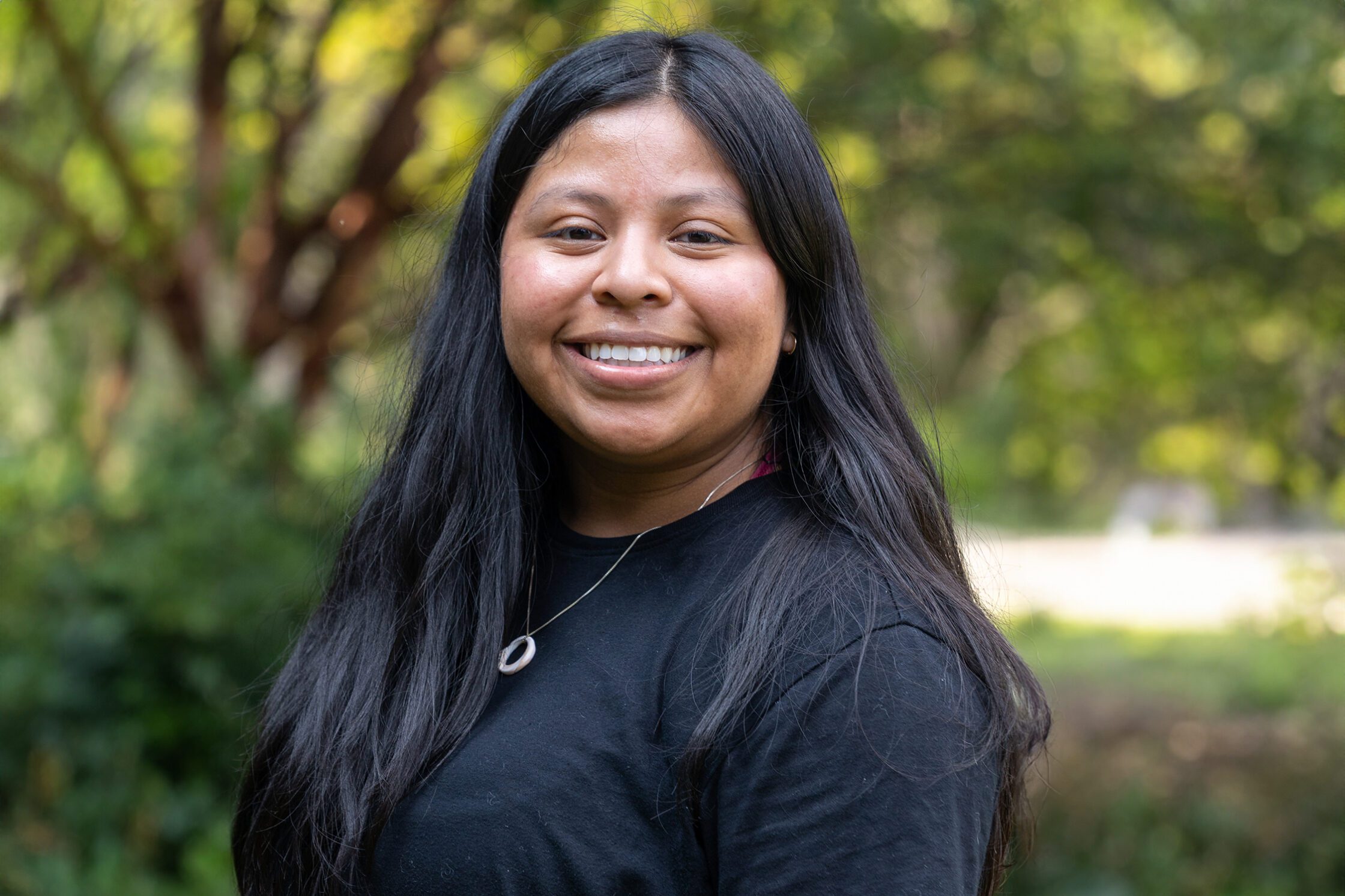
Having been adopted from Guatemala, Izzy Muraca ’26 had long hoped to write her thesis on an international topic, and a string of courses on political violence pointed her toward her birth country’s history.
The result, “Genocide as a Military Strategy: Guatemala’s Internal Armed Conflict, 1978–1983, and the Shift to Mass and Indiscriminate Violence,” examines how the Guatemalan military’s internal conflict escalated into genocide against the Maya people and why that escalation happened when it did.
“This work was incredibly special to me,” says Muraca, a political science major with a minor in Peace, Justice, and Human Rights. “It helped me learn more about my birth country and the difficult past of the Maya people.”
Muraca’s advisor, Benjamin Collins 1920 Professor of Social Science Anita Isaacs, supported her with nearly four decades of scholarship on Guatemala. Isaacs pushed Muraca to keep searching for new explanations rather than settling for the first answer. “She was a wonderful mentor and guided me throughout the process,” Muraca says.
The thesis identifies the Guatemalan military’s own role as the central driver behind the shift to mass, indiscriminate violence. By focusing on the precise moment the shift occurred, Muraca’s research points to a framework she believes could be applied to other genocide cases, helping researchers understand not only why violence happens but, more specifically, why it happens when it does.
The research process itself left as deep a mark as the findings. Muraca had never undertaken work at this depth previously and found herself repeatedly pulled down research rabbit holes in the pursuit of context. “One of my biggest takeaways, not only from my thesis but from my entire Haverford experience, is that knowledge is incredibly valuable,” she says. “The power of curiosity and background knowledge became invaluable to the way I process and learn.”
Muraca is currently interning on Capitol Hill and hopes to remain in Washington, D.C. for a few years. While the work isn’t directly related to her thesis, she still sees it as a step toward figuring out how to channel her interests into a career of advocacy. The thesis, she says, has already shifted how she sees the world.
“This thesis has definitely changed my perspective,” she says, “and will stay with me throughout my career.”