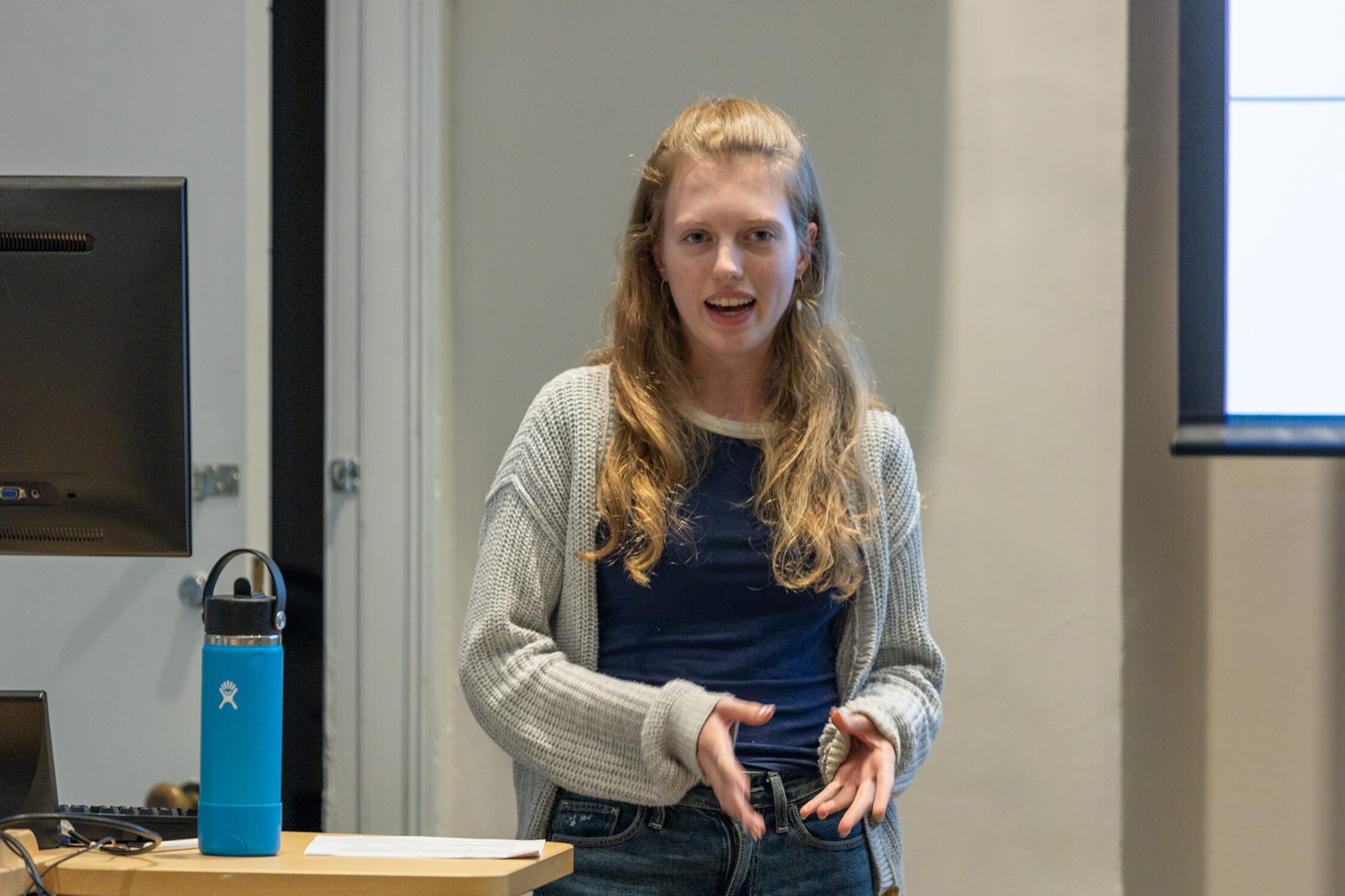
Every chatbot query carries a hidden water and energy toll, and for her thesis, Erin Dougherty ’26 set out to measure exactly how much. “GPT-Footprint: Quantifying the Water Footprint of Generative Artificial Intelligence” began as a pitch from Shibulal Family Computer Science Professor Sorelle Friedler at the start of the academic year, but immediately appealed to Dougherty, a computer science major with minors in environmental studies and data science.
Dougherty’s work is a method for tracking the water and energy consumption and carbon emissions of individual ChatGPT queries. The data she gathered has been aggregated on a public website, gptfootprint.cs.haverford.edu, visualizing artificial intelligence’s environmental impact. Dougherty says she designed the project as a foundation for others to continue building on, opening the door for larger user samples and deeper analysis in the future.
Friedler provided steady support throughout the project, Dougherty says, helping shape her research, structure her code, and encouraging her to stay open to new approaches as the work evolved. “She has been instrumental in shaping the direction of my research and my final results and interpretation,” Dougherty says.
Throughout the process of writing her thesis, Dougherty says she learned to structure and plan a long-term project and write about computer science for those outside of the field. “My biggest takeaway is the importance of perseverance in the face of a large project,” she says. When she hit dead ends, discussing ideas with Friedler and her peers often revealed new approaches, she says.
Dougherty also brought an ethical lens to her work through the Kim Institute for Ethical Inquiry and Leadership’s Thesis Fellows program, where cross-disciplinary conversations pushed her to consider who her project might affect. That blend of technical skill and social purpose is exactly what Dougherty hopes to carry with her into her post-College life.
“This thesis is a perfect example of what I am hoping to continue working on,” she says, “as it requires the application of technical skills to create a product that will, hopefully, bring awareness to the environmental impact of generative AI on a societal scale.”