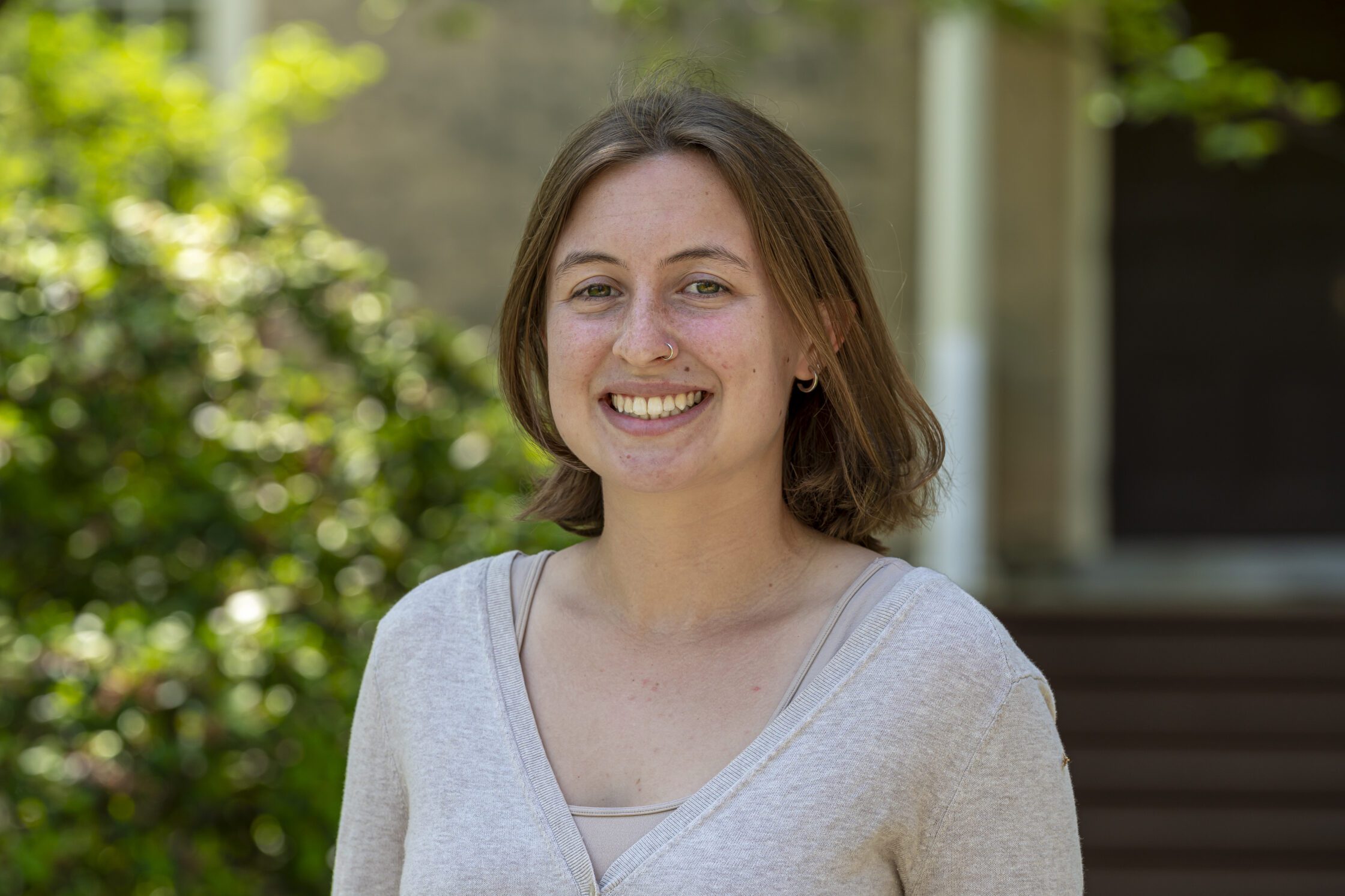
Audrey Carter ’26, a psychology major with a minor in child and family studies from Bryn Mawr, will land in Boston this fall, where she’ll begin work as a clinical research assistant at Boston Children’s Hospital. Carter joins a multi-site autism research network led by the Rosamund Stone Zander and Hansjoerg Wyss Translational Neuroscience Center, and will collect data that may shed light on the natural history of autism.
The role sits squarely at the intersection of the two areas of psychology Carter found most compelling during her time at Haverford: clinical psychology and behavioral neuroscience. Neuropsychology, her focus, sits at the intersection of both, she says. When Carter first arrived at Haverford, she thought she’d study math or political science, but an introductory psychology course in her first semester redirected her trajectory. Her long-term goal is a career in neuropsychology, in which she hopes to work with individuals with neurodevelopmental disabilities in an academic research hospital setting. Carter also plans to apply to Ph.D. programs in clinical psychology in a few years.
Many courses left a lasting impression on Carter during her time at the College. “Laboratory in Eye Tracking Methods” with Professor of Psychology Rebecca Compton introduced her to biometric research methods through hands-on experiment design. This spring, “Developmental Behavioral Neuroscience” with Prockop Assistant Professor of Neuroscience Patrese Robinson-Drummer drew her into scientific literature focused on rodents in ways she says she found unexpectedly fascinating. Classes outside of her major, such as “French in Common: Allochthonous and Indigenous Voices in Québec” with Professor of French Christophe Corbin, which included a class trip to Montréal and Québec City over fall break, helped round off her Haverford experience.
“Being able to think flexibly and within multidisciplinary contexts is an integral part of a liberal arts education in my opinion,” she says, “and I’m sure will be an asset professionally.”
Carter found an important mentor in her thesis advisor, Assistant Professor of Psychology Shu-wen Wang, who guided her through the research process by drawing on her own clinical training and practice outside of her faculty role. Her major and minor advisors, Professor of Psychology Jennifer Lilgendahl and Visiting Assistant Professor of Psychology Jodie Baird at Bryn Mawr were also consistent supporters, Carter says.
Carter says summer internships at the May Institute and the Lurie Center for Autism clarified her direction in meaningful ways. At the May Institute, she discovered she enjoyed working with populations with neurodevelopmental disabilities, while at the Lurie Center, she saw for the first time what the integration of research and clinical practice could look like.
On campus, Carter was a member of the leadership board of the Haverford chapter of Best Buddies, an organization that plans events with community members with intellectual and developmental disabilities. She was also a member of the cross country and track and field teams, an experience she describes as integral to her education.
“I have learned an unbelievable amount about leadership, resilience, ambition, and time management by being a college athlete,” she says, crediting coach Annick Lamar’s significant influence.
As the Class of 2026 steps into the world, Carter offers this to her classmates: “While it is definitely a scary time to be graduating and heading into the world right now, I hope you are able to take pride in all that you’ve accomplished over the past four years at Haverford and enjoy this time as much as possible.”