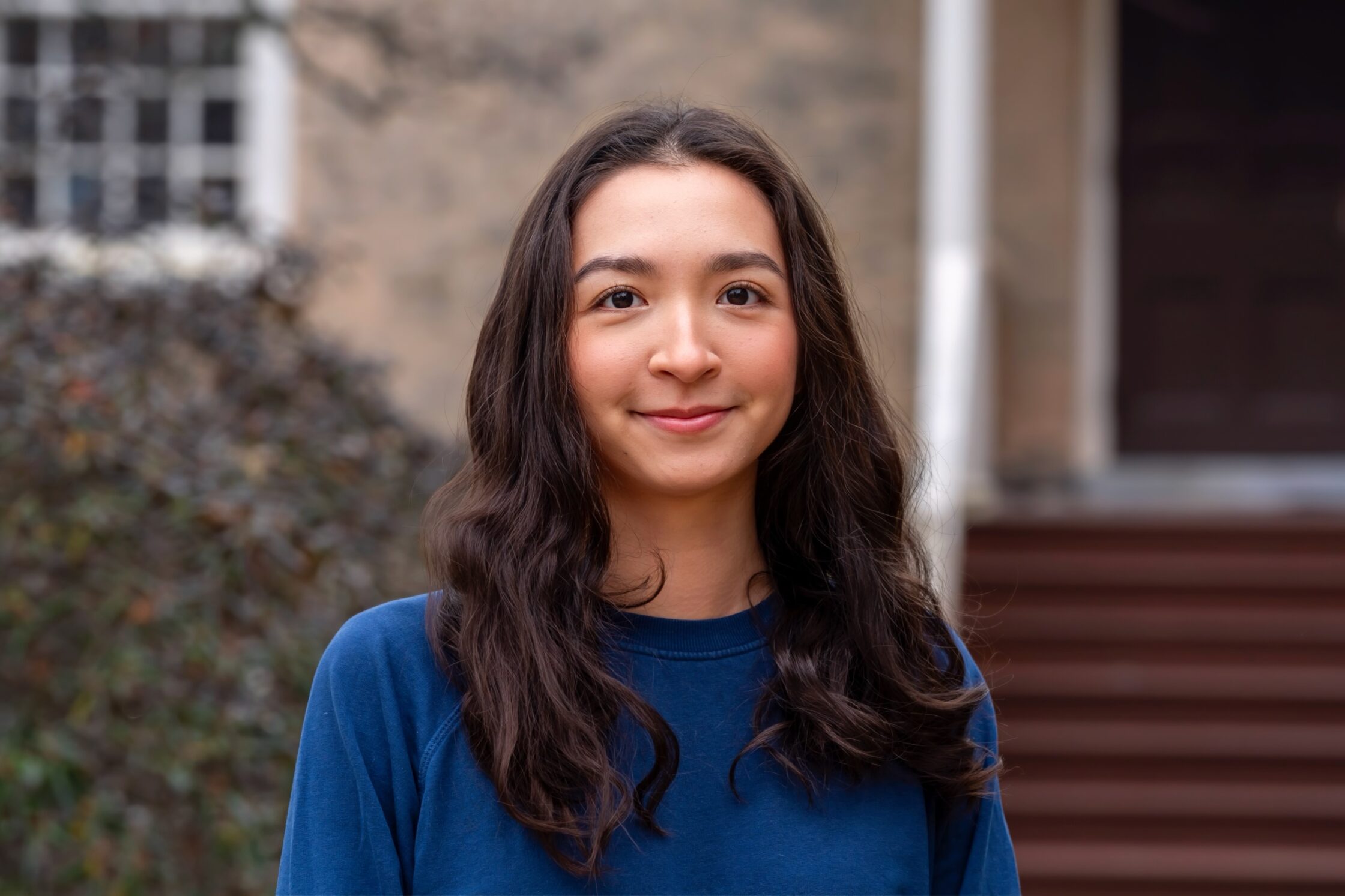
Alia Abulgazieva ’26 says she has always been drawn to the way microorganisms build complex molecules from scratch. Type I polyketide synthases, a class of protein complexes that function much like molecular assembly lines, immediately captured her imagination because many of the natural compounds they produce can be used to make antibiotics and other life-saving medicines. The connection between molecular science and medicine is what drew her to Professor of Chemistry Lou Charkoudian’s lab.
Abulgazieva’s thesis, “Exploring Acyl Carrier Protein Self-Acylation in Type I Polyketide Synthases,” investigates a surprising behavior described in a 2023 paper: Certain acyl carrier proteins, small but essential components of the biosynthetic assembly line, can pick up chemical building blocks without the help of a partner enzyme. Abulgazieva and Charkoudian set out to explore whether that behavior could be transferred to other proteins and whether the conditions that enable it could help researchers predict and control the process. Because polyketide synthases produce so many medically important compounds, Abulgazieva says a clearer picture of how these proteins behave could expand the biosynthetic toolkit and support the development of new therapeutics.
The project took on an unusual dimension when parts of it were incorporated into the design of Haverford’s Biochemistry Superlab. As a TA for the course, Abulgazieva was simultaneously teaching students to express and characterize proteins while developing those same skills herself. “Teaching and research constantly informed each other,” she says, “and I really enjoyed that experience.” Charkoudian, she notes, created a space where curiosity was always encouraged, an atmosphere she credits with helping her grow both as a scientist and a leader.
The time she spent in Charkoudian’s lab also taught her about the nature of research itself. “One of the biggest lessons I learned is that science is built on failure just as much as success,” she says. “Experiments rarely work perfectly the first time, and a huge part of research is learning how to troubleshoot, adapt, and keep asking better questions instead of getting discouraged.”
For Abulgazieva, a first-generation college student from Philadelphia, completing the thesis carried personal weight. “Writing this thesis felt like more than just finishing a project,” she says. “It felt like proving to myself that I belonged in these spaces.” After Haverford, she plans to pursue a career in clinical research and medicine, still drawn to work that bridges scientific discovery and patient-centered care.
“Haverford gave me the opportunity to grow not only as a scientist, but also as a communicator, mentor, and leader,” she says. “I learned how important collaboration and community are in science, and I hope that balance will continue to shape me.”