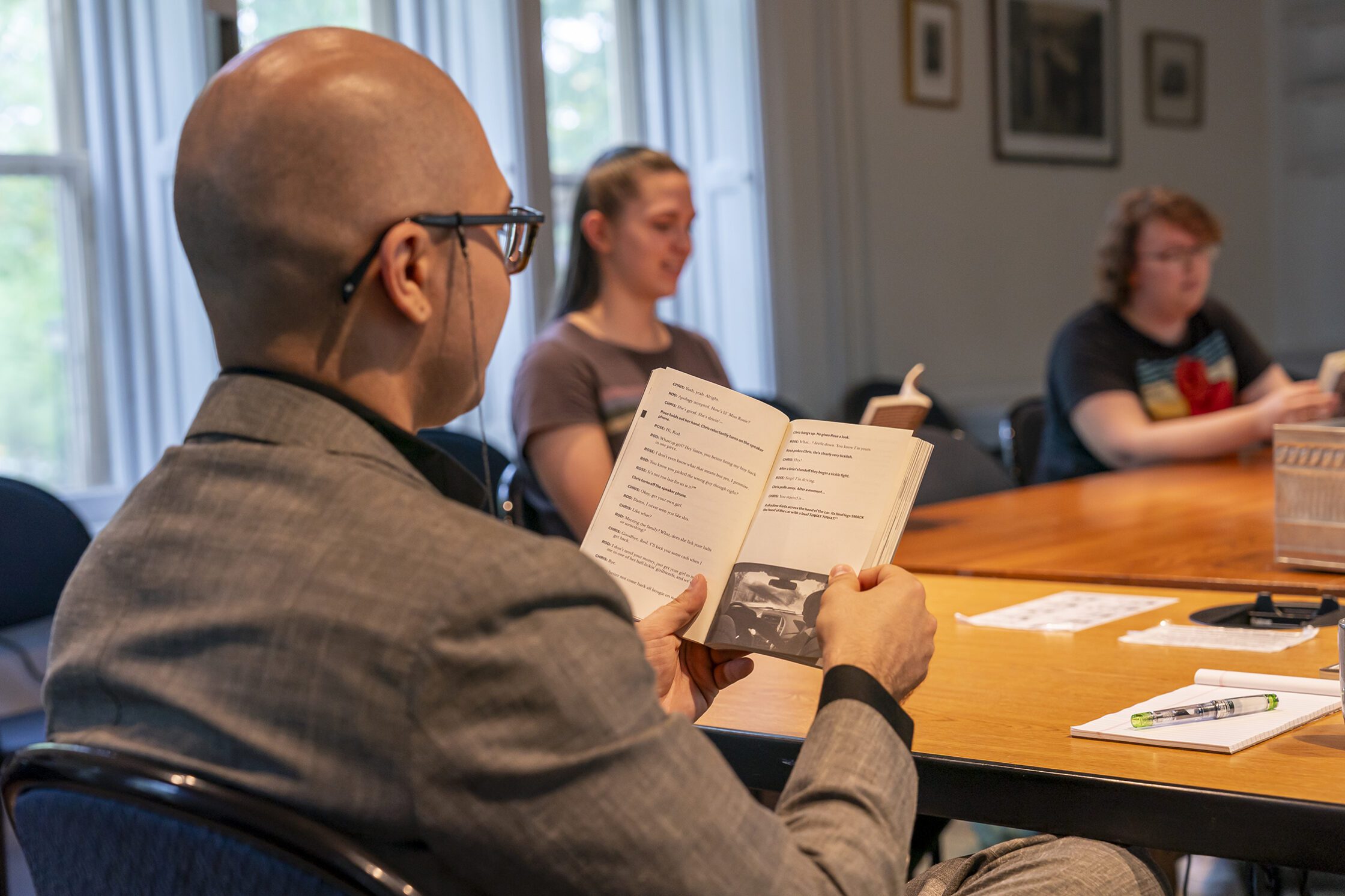
In Visiting Assistant Professor of English J. Felix Gallion’s hands-on English course, students explore the film table read as a site of creative experimentation and literary analysis. Blending elements of screenwriting, directing, and acting, the class invites students to dissect and perform scenes from popular films to understand how story, dialogue, and performance intertwine.
Tell us what your class is about. What do you hope students will take away from it?
A table read is the moment a film cast and crew get together and read the entire film script from front to back. We focus on the table read as a specific site where story, dialogue, and performance are workshopped and refined and where everyone in a film’s production does some form of literary and performance analysis in order to do their job on set.
The class is structured as a practicum, or a class focused on gaining specific skills based on observation and practice. Students learn the fundamentals of screenwriting, acting on screen, and directing through studying and performing scenes from three films: Jordan Peele’s horror magnum opus Get Out, John August and Daniel Wallace’s fantasy Big Fish, and Rachel Sonnet and Emma Seligman’s hit high-school comedy, Bottoms.
My hope is that students will take away an understanding of how films are made, the importance of narrative theory to the film production process, and practical skills for a career in the industry.
Why did you want to teach this class? What drove you to create it?
The first line of the syllabus says, “This course is what happens when a theater kid gets a Ph.D. in English.” I went to film school as an undergrad, and my interest in English was always about finding unique ways to tell the kinds of stories I was interested in telling.
As a scholar, filmmaker, and performer, I wanted to create a class where students could learn about storytelling, TV and film production, and performance simultaneously. For me, all of these things come together at the moment of a production’s table read, the moment when everyone involved in telling a movie’s story get together to work out the details. Giving students the opportunity to inhabit that space and experiment within it gives them not only a solid grounding in literary and performance theories but also practical skills if they want to go into the movie industry.
What makes your course unique to the English department?
The class is unique in approaching screenplays themselves as literary texts for analysis. Literary studies love to analyze theatrical plays and experimental literature, but the screenplay as a piece of literature is left to the wayside. This class tries to change that perspective by showing that the form of a screenplay is the most literary of works by allowing many different kinds of people with different artistic and technical jobs to collaborate through individual and collective interpretation. I think it’s also unique in that the class also very much about embodiment and actively exploring a written story through performance. There is a lot of doing and a lot of play, as all of our analysis gets translated into the final table read performances.