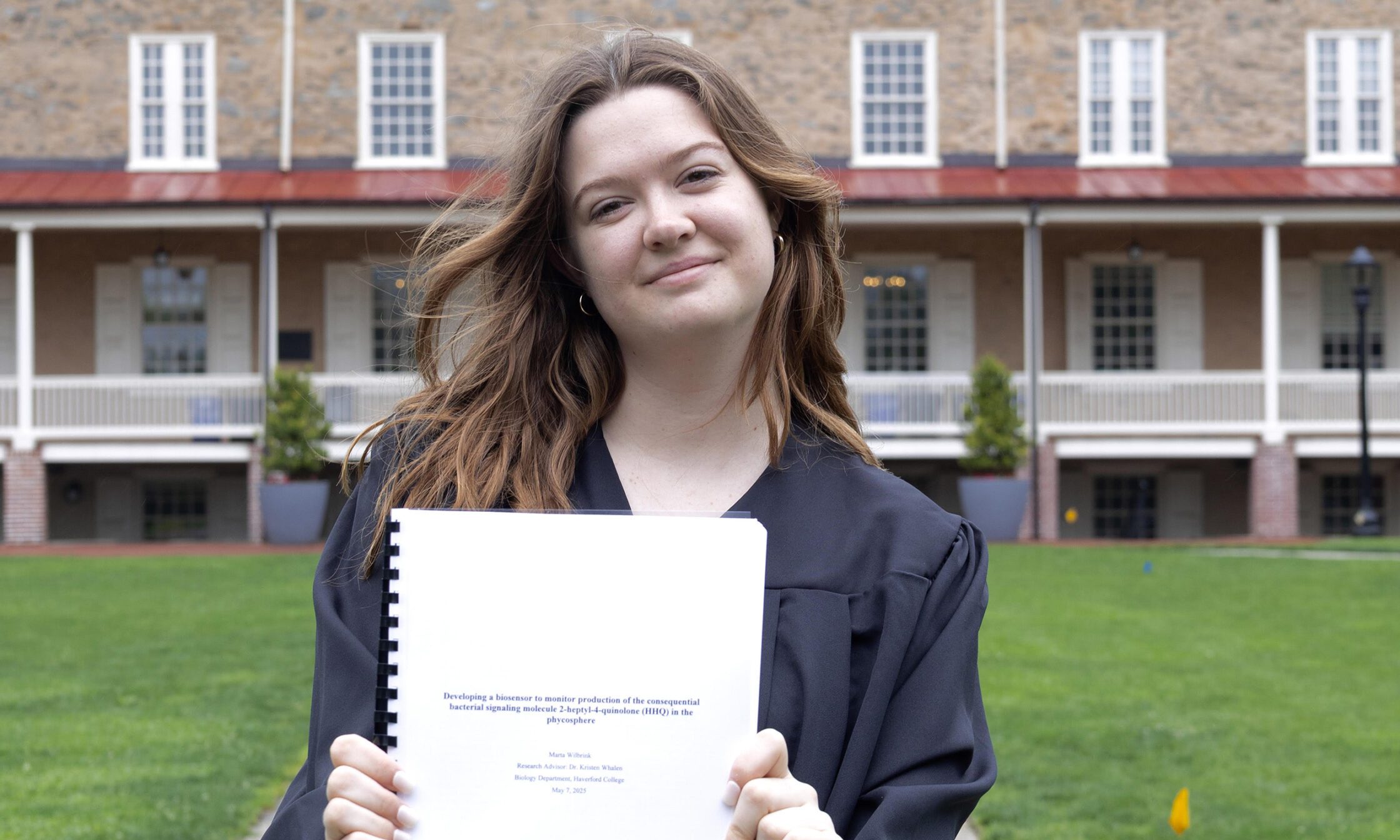
Marta Wilbrink ’25, a biology major who minored in chemistry and health studies, began a full-time position as a research associate at the Broad Institute of MIT and Harvard. She’ll join the Hacohen Lab, where she will contribute to immunology research aimed at designing more effective cancer therapeutics.
“When I came to Haverford, I knew I wanted to work in the pharmaceutical industry and help discover new therapeutics,” she says. “But I didn’t know how to achieve that goal or what specific type of work I was interested in.” Research experiences in Haverford’s biology and chemistry departments, as well as internships with Bristol Myers Squibb and Leiden University in the Netherlands, helped illuminate her path.
Wilbrink says her long-term goal is to achieve a Ph.D. in biomedical sciences or immunology and eventually work in pharmaceutical research and development. She credits her minors for contextualizing her biology coursework and encouraging her to think about the moral and societal implications of the pharmaceutical industry.
Haverford’s advanced lab classes, better known around campus as superlabs, were among her favorites and allowed her to participate in short, intensive research projects. Those experiences sharpened her research skills and introduced her to new topics and techniques. “These kinds of research classes are very unique to liberal arts colleges like Haverford,” she says. “We get to work directly with multiple professors and form genuine connections with faculty.”
Classes outside of her major also made an impact. She also highlights the John R. Coleman Associate Professor of History Andrew Friedman’s “Political Technologies of Race and the Body” with helping her understand the broader historical and cultural implications of drug development. Wilbrink says she conducted a research project on how quinine, used to treat malaria, was used by the United States and its military in the 19th century, giving her a framework to understand how drug design is “intertwined with culture and the perceived ‘value’ of patients.”
Wilbrink says she found an “incredible mentor” in Professor of Biology Kristen Whalen, who she first connected with as a pre-major advisor. Wilbrink worked in Whalen’s lab for much of her time at Haverford and found guidance from her when applying for internships, study abroad opportunities, and, most importantly, how to become an independent and rigorous researcher.
“Working in her lab is what made me fall in love with research and the process of scientific discovery,” Wilbrink says.
As she looks ahead to graduate studies and continued research, Wilbrink hopes her classmates also find meaning and purpose in their post-Haverford lives. “Most of all, I hope that all of my classmates find a career or further education that brings them fulfillment and joy,” she says.