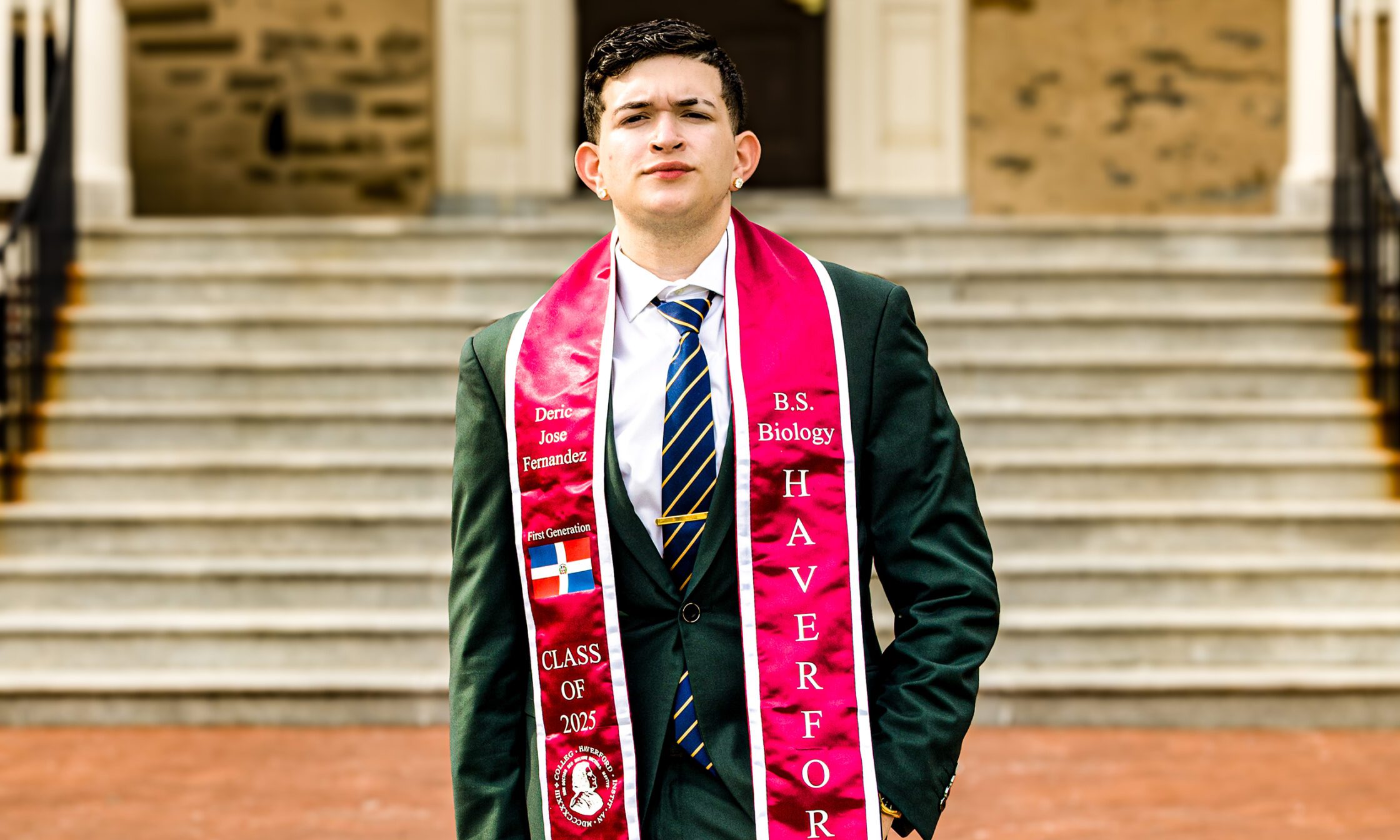
After a gap year to spend time working as an EMT, Deric Fernandez ’25, a biology major on the pre-med track, will prepare to take the MCAT as he sets his sights on a career as an emergency medicine physician.
“As a first-generation college student,” Fernandez says, “Haverford provided me with both rigorous academics and a supportive environment that empowered me to pursue my dreams.” His time at Haverford helped him think critically about healthcare, he says, not just as a science, but as a social and structural system that affects patient outcomes. “This holistic approach has shaped my desire to practice medicine in a way that is compassionate, equitable, and community-centered.”
Courses like “Social Relevance of Chemistry” with Professor of Chemistry and Provost Helen White allowed him to explore how science intersects with justice and society. Working with his senior thesis advisor, the Elizabeth Ufford Green Professor in the Natural Sciences Rachel Hoang, helped him become a more confident scientist.
“She gave me space to grow and supported me at every step,” he says of Hoang. “Her support was vital to building my confidence, especially during moments of uncertainty, and that confidence will continue to shape my work ethic as I move forward in my journey to becoming a physician.”
Fernandez also credits Assistant Professor of Biology Amy Cook with teaching him the importance of self-advocacy and accountability, values he plans to carry into his medical career.
Beyond his time in the lab, Fernandez was a leader in Haverford’s Customs program, where he says he learned how to take initiative, support others, and balance logistics with care, all skills he expects will translate directly to clinical settings.
In the long term, Fernandez hopes to return to his hometown of Boston to practice emergency medicine, where he can give back to a community that has long supported him and shaped his life. He also hopes to mentor underrepresented students pursuing medicine, just as others did for him. “I want to provide high-quality, compassionate, and accessible care to the people I grew up with, many of whom face barriers to healthcare access. Being able to serve in the place where my roots are is a responsibility and a privilege I take seriously,” he says.
Fernandez offers this wish to his fellow graduates: “I hope we keep asking the hard questions and showing up for the communities and causes that matter most. I believe that by staying true to ourselves and supporting each other, we can create meaningful change and build lives full of purpose and connection.”