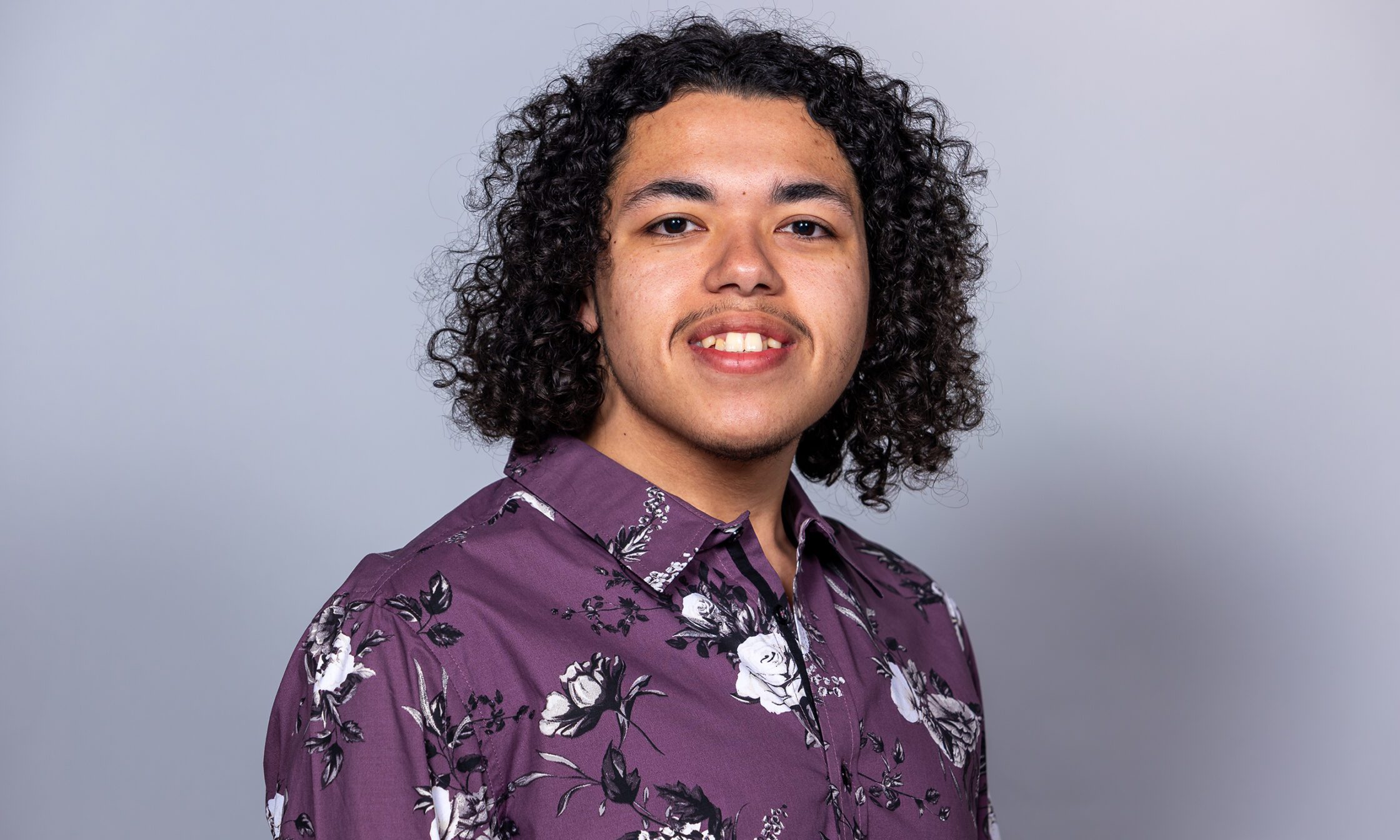
A sociology major with concentrations in Latin American studies and peace, justice, and human rights, Santos Diaz ’25 has spent much of this summer working as a research intern with the Ira Reid Foundation. Founded by Haverford alums, the foundation honors the legacy of the influential professor and community organizer.
Next month, Diaz, a Questbridge scholar, will begin serving as a fellow with 12+, a Philadelphia-area nonprofit that works to expand access to higher education in disadvantaged communities. Díaz will be working at 12+’s Camden High School Center, located across the Delaware River in southern New Jersey.
“My role as a student advisor and school culture agent will entail facilitating workshops, planning school-wide culture events, and maintaining the Plus Center as a safe and structured space for student life,” Diaz says. After completing the fellowship, Diaz plans to pursue graduate studies at the University of Toronto’s Munk School of Global Affairs & Public Policy.
After graduate school, Diaz says he aspires to a career in global studies and international diplomacy, one that will allow him to inform policy that supports nonprofit organizations and NGOs in their efforts around the world, particularly in response to crises, wars, and human rights violations.
“My time working in the Peace, Justice, and Human Rights department at Haverford provided me with the theoretical foundation I needed to understand systems of power and techniques of negotiation in order to facilitate international policy and reform,” he says. “Haverford’s overall student body and their push in the classroom to always view social and political issues from a global frame is what gave me the assurance that I wanted to work in international policy.”
Several Haverford courses were foundational in his path, including “Anthropology of Human Rights,” “Sociology of Art,” “Myths of Technology,” “Musical Cultures of Afro-Latin America,” and “Rio de Janeiro, Past & Present.” Diaz also considers Amy Harris, a lecturer at the University of Michigan’s Ford School of Public Policy, a key mentor. Diaz met Harris through his participation in the Ford Junior Summer Institute, where her class on international development policy introduced him to foreign aid contracting and policy.
Looking ahead, Diaz hopes to travel as much as possible, now that he has obtained his very first passport. He also sends his classmates off into their post-College lives with this wish: “As we enter the world, may we seek love and common ground, even with enemies, and strive to leave the world more whole and forgiving than we found it.”